
Did your ancestors leave you land in Slovakia?
Answer a few simple questions and we will take you through the whole process of settling the land – whether that means inheriting from relatives who have died, getting shares from living owners or selling your own share.
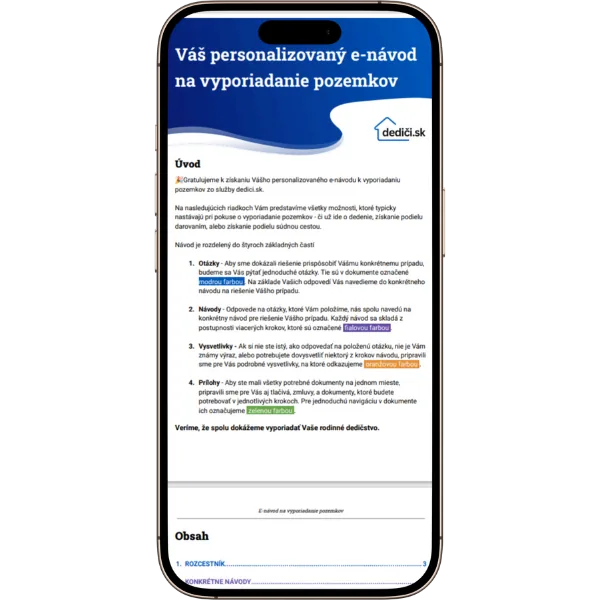
Interactive guide to your case
Based on your answers, we will point you to the specific guide for your case. If you are not sure about an answer, the explanations under the questions will help.
First question
What would you like to do?
Inheritance · question 1 of 3
Is your ancestor still alive?
💡 What does “unknown owner” mean?
Sometimes a person is recorded in the Slovak land registry as an “unknown owner” even though they are still alive. You can usually tell because their date of birth or permanent address is missing from the title deed (list vlastníctva, LV). An unknown owner cannot deal with their share, because it is administered by the Slovak Land Fund (SPF).
Result
There is no right to inherit yet
❌ As long as the owner is alive, the share cannot be inherited. You can, however, get the share by buying it or receiving it as a gift.

Would you rather leave it to us?
Describe your case to us – we will look into it and suggest the next steps. Mgr. Jakub Žilinčan, PhD.
✉️ Describe my caseResult · Your next steps
Help your ancestor get their details recorded in the land registry
✅ As long as your ancestor is recorded as “unknown”, their share is administered by the Slovak Land Fund and they cannot deal with it. The solution has two steps:
- Adding their identification details to the land registry – your ancestor becomes an “identified” owner and the SPF no longer administers the share.
- Your ancestor can then sell or give you the share – or deal with it in any other way they choose.
Would you rather leave it to us?
Describe your case to us – we will look into it and suggest the next steps. Mgr. Jakub Žilinčan, PhD.
✉️ Describe my caseInheritance · question 2 of 3
Are you a direct descendant of the ancestor?
A child, grandchild, great-grandchild… – the so-called direct line of descent.
💡 What does “direct line of descent” mean?
Put simply, a direct line of descent means that you could, in theory, draw a family tree leading from the ancestor straight down to you. It mainly includes parents, grandparents and great-grandparents. In some cases it can also be a husband or wife, siblings or even an uncle, but inheriting can then be more complicated. Cousins, on the other hand, are not part of the direct line.
Whether you are in the direct line has to be proven by supporting documents – birth, death and marriage certificates, and extracts from the land books or civil registry records.
Result
You have no right to inherit
❌ Outside the direct line of descent you have no right to inherit. You can, however, get a share from one of the living co-owners by buying it or receiving it as a gift, and then settle the co-ownership, possibly all the way to sole ownership.
Would you rather leave it to us?
Describe your case to us – we will look into it and suggest the next steps. Mgr. Jakub Žilinčan, PhD.
✉️ Describe my caseResult · Your next steps
We will help you trace your line of descent
✅ All is not lost. Whether you are in the direct line of descent is proven by supporting documents – birth, marriage and death certificates, and extracts from civil registry records or land books. From these, the family tree can be “drawn” from the ancestor all the way down to you.
This research tends to take time – you have to go through civil registry offices, state archives and land books. We will be happy to do it for you.
Service: Tracing your line of descent
We will verify your family relationship to the ancestor and find the documents you need. Describe your case and we will prepare a plan tailored to it. You can also read how it works in the guide to finding proof of descent.
✉️ I want help with the researchInheritance · question 3 of 3
Do you have documents that prove your direct family relationship?
Birth, marriage and death certificates, extracts from civil registry records or land books.
💡 Which documents will I need?
Birth and death certificates, and extracts from the land books or civil registry records. These documents must make it possible to “draw” the family tree unambiguously from the ancestor through every generation in between down to you. You can get them from civil registry offices, state archives or the land books – yourself, through a notary, or we can help you find them.
Result · Your next steps
Ask the land registry to add the identification details
✅ You have everything you need. There are two more steps:
- Adding your ancestor’s identification details to the land registry – your ancestor becomes an “identified” owner.
- Opening probate proceedings – a notary (acting as court commissioner) settles the property that was never inherited.
Would you rather leave it to us?
Describe your case to us – we will look into it and suggest the next steps. Mgr. Jakub Žilinčan, PhD.
✉️ Describe my caseResult · Your next steps
First you will need to find the documents
✅ All is not lost. There are three steps:
- Finding the documents that prove your line of descent – civil registry offices, state archives, land books.
- Adding your ancestor’s identification details to the land registry.
- Opening probate proceedings before a notary.
Would you rather leave it to us?
Describe your case to us – we will look into it and suggest the next steps. Mgr. Jakub Žilinčan, PhD.
✉️ Describe my caseShares · question 1 of 3
Is the co-owner you want to get the share from still alive?
💡 How do I find out whether the owner is still alive?
The simplest way is to contact them directly – in person or by mail at the address shown on the title deed. Neighbors or the municipal office are also a good source of information. You can also estimate the likelihood from the date of birth on the title deed (e.g. if the owner was born in 1920, we can assume they are no longer alive).
Result · Your next steps
You can get the share as a gift or by buying it
✅ With a living owner this is fairly simple – a deed of gift or a purchase contract plus an application for registration in the land registry. If the share is sold, watch out for the other co-owners’ right of first refusal.
Would you rather leave it to us?
Describe your case to us – we will look into it and suggest the next steps. Mgr. Jakub Žilinčan, PhD.
✉️ Describe my caseShares · question 2 of 3
Is the Slovak Land Fund (SPF) also on the title deed?
💡 How do I find out whether the SPF is on the title deed?
Open the title deed and check whether the abbreviation (SPF) appears next to the name of the co-owner you want to get the share from, whether the Slovak Land Fund (Slovenský pozemkový fond) is listed as administrator, or whether the owner’s date of birth is missing.
Shares · question 3 of 3
Is your name on the title deed?
…and the SPF is listed on the title deed.
Result · Your next steps
We recommend settling it through the court
✅ It is possible to buy the land from the SPF, but we recommend having the co-ownership dissolved and settled by the court.
Would you rather leave it to us?
Describe your case to us – we will look into it and suggest the next steps. Mgr. Jakub Žilinčan, PhD.
✉️ Describe my caseResult · Your next steps
You can buy the share from the SPF
✅ It is possible to buy the land from the Slovak Land Fund. The process can, however, take quite a long time. The SPF describes the exact procedure on its website (in Slovak).
Would you rather leave it to us?
Describe your case to us – we will look into it and suggest the next steps. Mgr. Jakub Žilinčan, PhD.
✉️ Describe my caseShares · question 3 of 3
Is your name on the title deed?
…and the SPF is not listed on the title deed.
Result · Your next steps
You can get the share through the court
✅ You can get the share of a deceased co-owner through the court – with a lawsuit for the dissolution and settlement of co-ownership.
Would you rather leave it to us?
Describe your case to us – we will look into it and suggest the next steps. Mgr. Jakub Žilinčan, PhD.
✉️ Describe my caseResult · Your next steps
The heirs will need to be traced
❌ The potential heirs of this co-owner will need to be traced and probate proceedings opened with them. Once they have inherited, they become owners of the parcels and can deal with them – for example, sell them to you or give them to you.
This situation is fairly complicated, because it requires the cooperation of several people, each of whom may have different motives.
Would you rather leave it to us?
Describe your case to us – we will look into it and suggest the next steps. Mgr. Jakub Žilinčan, PhD.
✉️ Describe my caseResult · Your next steps
Selling your share of land
✅ You can sell your share – but watch out for the other co-owners’ right of first refusal. You must first offer them the share in writing on the same terms; you can transfer it freely only to a close person under Slovak law (e.g. your children or siblings).
- Offer the share to the co-owners – use the template Offer to exercise the right of first refusal.
- Once the time limit (2 months) has passed or the co-owners have waived their right, you can sell the share to a third party with a purchase contract.
- Complete the transfer with an application for registration in the land registry.
Not sure whom to sell to? Describe your case – we can estimate the value of the share and advise you on how to proceed.
Would you rather leave it to us?
Describe your case to us – we will look into it and suggest the next steps. Mgr. Jakub Žilinčan, PhD.
✉️ Describe my caseNot sure what to do in your case?
The guide covers common situations, but every case is a little different. Describe yours to us, or leave us your phone number (with the country code) and we will call you. The first consultation comes with no obligation.
📞 We’ll call you
Leave us your phone number, including the country code, and we will call you – no need to write anything. The first consultation comes with no obligation.
We will use the number only to call you back about your case. More in our Privacy Policy.
All step-by-step guides
Don’t want to go through the questions? Here is the complete list of our step-by-step guides.
🌳 Inheriting land from your ancestors
🤝 Acquiring shares in land parcels
Frequently asked questions
What does “unknown owner” mean?
A person can be recorded in the Slovak land registry as an “unknown owner” even though they are still alive. You can usually tell because their date of birth or permanent address is missing from the title deed (list vlastníctva, LV). An unknown owner cannot deal with their share, because it is administered by the Slovak Land Fund (SPF).
What does “direct line of descent” mean?
A direct line of descent means that you could, in theory, draw a family tree that leads from the ancestor straight down to you. It mainly includes parents, grandparents and great-grandparents. Cousins, on the other hand, are not part of the direct line.
Which documents prove the line of descent?
Birth, death and marriage certificates, and extracts from the land books or civil registry records. The documents must make it possible to “draw” the family tree unambiguously from the ancestor through every generation in between down to you. You can get them from civil registry offices (matrika), state archives or the land books.
How do I find out whether an owner is still alive?
The simplest way is to contact them directly – in person or by mail at the address shown on the title deed. Neighbors or the municipal office are also a good source of information. You can also estimate the likelihood from the date of birth on the title deed.
How do I find out whether the Slovak Land Fund (SPF) is on the title deed?
Open the title deed and check whether the abbreviation (SPF) appears next to the co-owner’s name, whether the Slovak Land Fund (Slovenský pozemkový fond) is listed as administrator, or whether the owner’s date of birth is missing.
Didn’t find your situation?
Start with a free search for your ancestors, or describe your case to us right away – we will suggest the next steps.
🔍 Search for your ancestors for free ✉️ Describe my case
Is land consolidation (pozemkové úpravy) under way in the municipality where your land is? See the list of affected municipalities.